![]() |
![]() |
![]() |
![]() |
|
![]() ![]() ![]() |
![]() ![]() ![]() |
|||
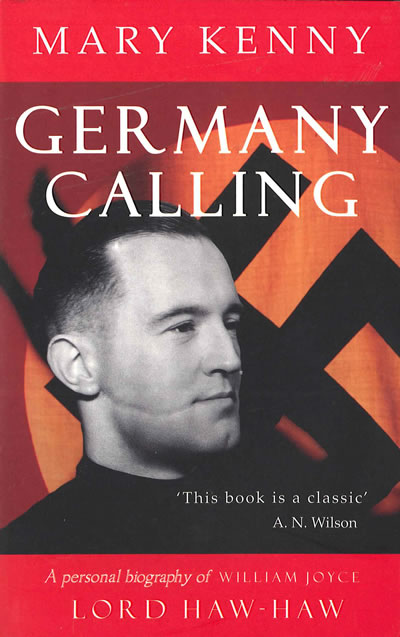
GERMANY CALLING - AN INTRODUCTION
|
||||
![]() |
||||
|
William Joyce was not a particularly nice man; and when he was bad he was horrid. The most disagreable streak in his personality was his pathological anti-Semitism, which was, as the Irish say, beyond the beyonds. If you said to Willliam, "It's rainey, today, isn't it?" he would reply, "Yes, and don't you know the Jews make all the umbrellas, and have a world monopoly in umbrellas, and are using the umbrella market to further their fiendish Communist Plot of International Finance." I have come to understand, I think, the source of this fixation, which I explain in the course of the text, but I would not go so far as to say that "tout comprendre, c'est tout pardonner". I don't think he should be pardoned for this, particularly in 1945, after the war, when the Nazi concentration camps were being opened up and he showed no scant remorse about the consequences of hate crime. It has to be said that there was nothing unusual in anti-Semitism during the 1930s. It was to be found in the work of Virginia Woolf, T.S. Eliot and George Orwell, the popular writing of John Buchan, Dornford Yates and Agatha Christie; it can be found in W.B. Yeats, and one of William Joyce's most ferocious admirers who almost outdid him in anti-Jewish feeling was the poet and mentor of poets, Ezra Pound. There was a certain element of joking anti-Semitism in the pre-war (but not post-war) lyrics of Noel Coward and it was evident in the essays of Wyndham Lewis. It appears in the amusing diaries of "Chips" Channon, the journalism of Beverley Nichols, the industrial philosophy of Henry Ford, in the eugenic texts of Karl Pearson and in the attitudes of the co-founder of the New Statesman, the Fabian Sydney Webb, who at least even-handedly thought that both the Irish and the Jews were unfit to breed. Anti-Semitism was also commonplace among ordinary people, as shown in the Home Intelligence Reports British Government monitors of what people in 13 regions around the United Kingdom were talking about during the war. Throughout the Second World War, grumbling about the Jews either for allegedly running a black market or seeming too "ostentatious" in their lifestyle was a much-repeated theme. So although William's anti- Semitism was unpardonable, it was but an inflated and possibly pathological amplification of a prejudice that many people shared. We must also remember that various racial and group prejudices were commonplace in the recent past: right up until the 1960s, English landladies plying for trade hung a "No Irish" sign in their front windows, sometimes with the variation, "No Irish, No Coloured". We know that Anti-Semitism is odious because we know the deepest pit of evil to which it led; but I also came to the view, in the time I spent with the ghost of William Joyce, that it is also unlucky. Not because there is a world conspiracy of Jews monopolising the media and controlling everything from governments to finance, as William and his colleague John Beckett believed: but because anti-Semitism produces in the individual a negative energy which burns away at all positive gifts and positive talents, and eventually consumes the good karma. And William Joyce did have good qualities, and interesting ideas, which have been annulled or overlooked by the flare of his violent hatreds. His political ideas were not all loathsome: some of his precepts about education could be endorsed, without alteration, by the most liberal-minded progressives of our day. He favoured much more equality in education: and much more emphasis on making children happy. His economic ideas about Ireland's woes were very sensible: he thought what Ireland needed was lots money invested in it, which has turned out to be exact. On a personal level, William had some of the attractive qualities of the absent-minded professor: he had no interest in possessions he only ever wanted wine, cigarettes, books and a few opera records - and always looked a bit of a mess. He was mechanically incompetent, couldn't ride a bicycle, dance or play games. He could speak on the radio but could "barely succeed in receiving a powerful station on the wireless and could never get the tuning really right", according to his friend John Angus Macnab. While he greatly irritated some people, he commanded the lifelong loyalty of close friends. He could be very good company when he was on form, and his friends sometimes saw William in unusual moods of mildness and even humility: "when he put aside his jackboots", said Chesterton, he could emerge "as a humble person, not without charm and with a delicate sense of irony". He eventually faced his own execution with equanimity. William Joyce did nearly everything wrong in his life, and certainly had some dreadful views; but he was not without redeeming qualities. Then, none of us are. |
![]() |